Improve Your Smile With Invisalign®
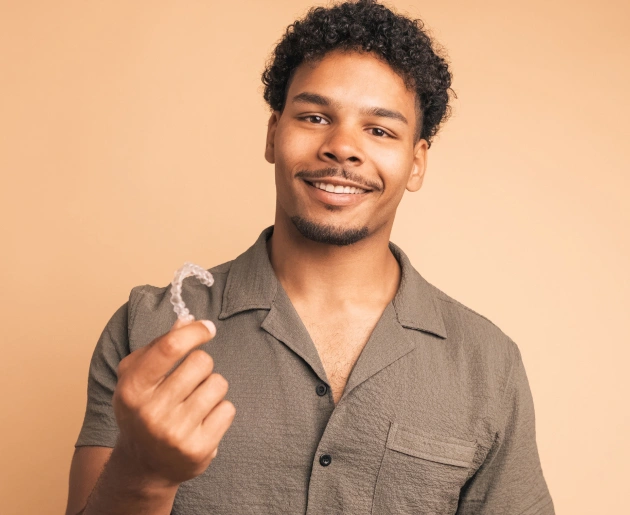
Appearance is not the only benefit of wearing Invisalign® for straighter teeth, since straighter teeth can also benefit one’s oral health. Crooked teeth can trap food between them, leading to infection or bite issues. At Escondido Family Dental Care & Specialty Center, we offer Invisalign® as a treatment for patients interested in discreetly straightening their teeth. Invisalign® is a series of clear aligner trays that cover the teeth, similar to a retainer or mouth guard, but are much more discreet. At least every two weeks, the patient will switch to the next set in the series of Invisalign trays. With custom aligners for each patient, Invisalign will gradually move the teeth into the correct position without causing significant pain.
The Process
To begin, we will need to conduct a consultation and examination. This examination will involve reviewing the patient’s medical history, current state of health, any pre-existing conditions or prescribed medications that we need to be aware of, and the position of the patient’s teeth. We will then take a mold of the patient’s teeth and measurements. With all of this information, we will send it to the lab to create the Invisalign® trays. After creating the trays, we will meet with the patient to ensure they fit correctly and that they understand all the steps in the straightening process. Patients must understand a few key factors about wearing Invisalign regularly.
Wearing the Aligners for at Least 22 Hours Per Day
While the patient can remove Invisalign trays when necessary, it is best to keep them in as much as possible. The longer the patient does not wear the trays, the longer the entire process will take. Patients need to remove the aligner trays when eating and to brush their teeth. Patients can also remove the aligner trays to play sports, give a presentation, go on a date, or take a photo. It is essential to at least rinse the mouth after eating to keep food from getting caught in the teeth.
Staying on Schedule
Since we do not need to adjust Invisalign® aligners at our office as one might need to adjust braces, patients do not need to make as many checkup appointments. In fact, by customizing the aligner trays, we can eliminate the need for regular orthodontic checkups. The patient will be able to continue through each aligner tray and follow a schedule with no surprises. By following the schedule, the patient’s teeth will continue to move into the proper position without pain.
Keep Up Regular Oral Hygiene
While wearing Invisalign®, patients will not have to brush and floss between brackets with difficulty. The patient will be able to brush and floss as usual by just removing the aligner trays. However, the patient must brush after each meal to keep food from sticking between the teeth. Food that is stuck in the teeth can also damage the aligners. Patients must refrain from wearing Invisalign® aligners while drinking soda or other beverages. We recommend that patients only keep the aligners in when drinking water.
Customized for Your Teeth
We customize the Invisalign® aligners to fit the patient’s teeth and then use programming technology to digitally map out the projected rate of movement for the patient. We will then manufacture the remaining clear aligners in the series. Each new set of aligners will be a bit closer to the correct position for straight teeth. With a customized straightening treatment, patients can rest assured that their aligners will stay in place and not fall out or become loose. Since there is no one-size-fits-all treatment, we make sure that the trays are the right fit for each patient.
Check out what others are saying about our Invisalign® services on
Yelp: Invisalign® Escondido.

Discreet, Efficient, and Easy to Use
Invisalign® aligner trays are nearly invisible to the point that few people will notice them unless the individual mentions wearing them. Patients will no longer have to feel embarrassed by wearing traditional metal braces or a tangle of wires in their mouth regularly. Invisalign allows patients to achieve the straight smile they desire without the maintenance required for traditional braces treatment. Patients will be able to feel confident in their smile during the straightening process. If you’re interested in Invisalign treatment in Escondido, please call us today to schedule an appointment. We will help you achieve the straight smile you’ve always wanted.
How do I get started with Invisalign®?
Call (760)-273-0531 and schedule a consultation with Dr. Raza.
Questions Answered on This Page
Definition of Invisalign® Terminology
Aligner Trays
With Invisalign® treatment, the patient will receive a series of aligner trays and swap out each one for the next one in the series every two weeks in order to gradually straighten the teeth.
Blue Compliance Indicator (Invisalign Teen)
The blue compliance indicator is a small blue dot on the aligners that fades from blue to clear, indicating whether the patient is wearing the aligner for the proper amount of time and their current stage in the Invisalign process.
ClinCheck® Software
ClinCheck® software allows professionals to map out the straightening process the patient’s teeth will go through with Invisalign® in great detail.
Gum Line
The gum line is the line in the mouth where the teeth and gums meet. If a patient struggles with gum recession, then the gum tissue around the teeth may begin to wear away.
Incisal Ridges
Incisal ridges are the portion of the crown of the tooth that makes up the incisal portion and can be a direct cause of overbite if they are extended too far.
An iTero Element scanner
An iTero Element scanner enables professionals to create a 3D image of the patient’s teeth in minutes and predict the necessary steps to move the teeth into proper alignment.
Malocclusion
Malocclusion is the condition in which the upper and lower teeth do not meet properly when the bite is closed. Conditions of malocclusion can include overbite, underbite, crossbite, and open bite; all of which are treatable with Invisalign®.
Polyurethane Resin
Polyurethane Resin is a USP Class VI medical grade, high molecular weight compound that makes up the Invisalign® aligners.
SmartForce Attachments
SmartForce attachments are small attachments that professionals place on the patient’s teeth before placing aligners to help move the teeth.
MaterialSmart Track®
Innovative Track® MaterialSmart Track®material is in Invisalign® aligners to increase comfort, improve control of movement, increase the speed of treatment, and apply a gentle force to the teeth over time.
Smile-Scan
Smile-Scan analyzes the way a patient smiles by measuring the position of the mouth and eyes before giving a score.
Vivera® Retainers
Vivera® retainers are a type of retainer that consists of transparent plastic material and helps to maintain orthodontic corrections after a treatment.
Helpful Related Links
- American Dental Association (ADA). Glossary of Dental Terms. 2015
- American Academy of Cosmetic Dentistry® (AACD). Home Page. 2015
- Invisalign®. How Invisalign Works. 2015
- Invisalign®. Take the Smile Assessment. 2015
- WebMD. WebMD’s Oral Care Guide. 2015
About our business, license, and website security
- Escondido Family Dental Care & Specialty Center was established in 1994.
- We accept the following payment methods: American Express, Cash, Check, Discover, MasterCard, and Visa
- We serve patients from the following counties: San Diego County
- We serve patients from the following cities: Escondido, San Marcos, Poway, San Diego, Vista, Encinitas, Solana Beach, El Cajon, Del Mar, Oceanside, Carlsbad and Temecula
- Norton Safe Web. View Details
- Trend Micro Site Safety Center. View Details