Restore Your Smile With Dental Implants
Missing teeth can be embarrassing, causing people to hide their smile and lose their self-esteem. The space that missing teeth create can easily become infected with bacteria, causing other teeth to shift out of place, and making it difficult for people to speak or eat correctly. The team at Escondido Family Dental Care & Specialty Center are sensitive to the hardship a missing tooth can create. We provide dental implants so that our patients can regain their self-confidence, improve their health, and approach life boldly.
Installing implants is a complex procedure that requires us to replace their missing teeth in a safe and natural way. We know that there are multiple dental providers to choose from, so the team at Escondido Family Dental Care & Specialty Center Center are constantly looking for ways to improve the overall experience of our patients. Our office is located in Escondido and we offer patients the opportunity to restore missing teeth in a way that looks natural and beautiful.
Facts from the American Academy of Implant Dentistry (aaid.com)
- More than 30 million Americans are missing all their teeth in one or both jaws
- 15 million people in the U.S. have crown and bridge replacements for missing teeth
- 3 million have implants and that number is growing by 500,000 a year
- 10% of all U.S. dentists place implants but that is increasing
- The success rate of implants has been reported in scientific literature as 98%
- Implants performed by U.S. dentists 5,505,720 (2006)
- Implants performed by U.S. general dentists 3,103,930 (2006)
- The dental implant market in the U.S. is projected to reach $5 billion by 2018
Questions to Ask When Selecting an Implant Dentist
- What treatment options do you use to restore missing teeth?
- How many implant procedures have you performed?
- What’s your success rate?
- What’s your education and training in implant treatment?
- Which technique* and type of replacement teeth or appliance do you recommend for me, and why?
- What steps are involved in the process and where and by whom are they performed?
- What should I expect throughout the process in terms of pain, recovery time, eating, etc.?
- Will I have teeth throughout the process?
- What type of anesthesia do you use?
- What are the risks of the treatment option you’re recommending?
- What are the benefits?
- Can you share before-and-after pictures of other patients you have treated?
The Process of Installing Implants
If one or more of your teeth fall out, you may qualify for dental implants as a way to permanently replace the missing teeth. In order to find out, schedule an appointment with our Escondido dentist office by calling (760)-273-0531. We will examine your mouth and jawbone to determine if the procedure is right for you. Before we begin the procedure, your gums need to be healthy, and your jawbone needs to be strong. If we identify any cavities or signs of gum disease, we will need to treat it prior to the dental implant procedure.
Once you are cleared for the procedure, the staff at Escondido Family Dental Care & Specialty Center will take an impression of your mouth to create a new tooth in a dental lab. Each synthetic tooth will match the size and shape of the surrounding teeth, along with having a perfect color match. This way your smile will appear completely natural once we complete the procedure. Many patients are satisfied with the results since no one can tell the difference between which teeth are real and which ones are synthetic.
Teeth restored with implants will not get cavities. A replacement tooth, or crown, does not decay like a natural tooth. However, you still need to brush, floss and care for it and your surrounding natural teeth in the same manner as natural teeth. Regular professional cleanings and dental checkups are also essential.
Escondido Dental Implants
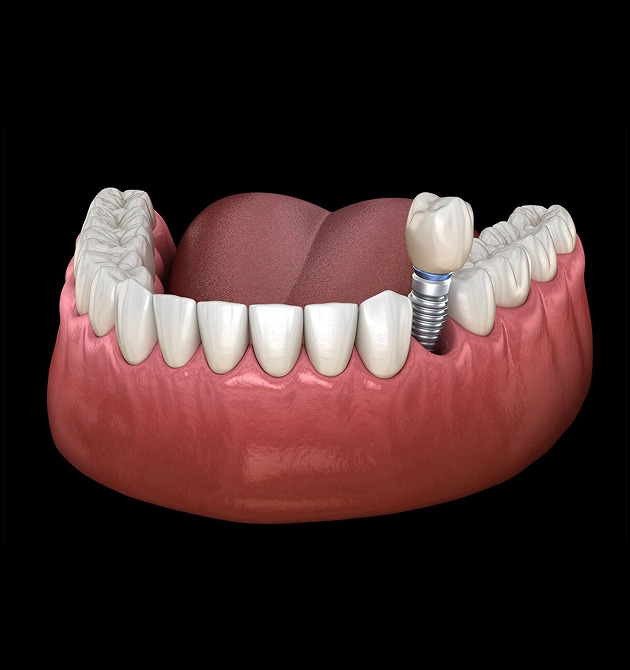
The next step in the procedure is to implant a metal post under the gum line. This aspect of the procedure is what sets an implant apart from other forms of cosmetic dentistry. The metal post is secured to the jawbone in order to create a durable, synthetic root system that rivals the strength of natural roots; with one exception that the metal cannot face infection. Over the course of a couple of months, the metal post and jawbone will fuse together. This creates a level of durability that cannot be replicated in other types of procedures.
Afterward, we will secure the new synthetic tooth to the metal post at the surface of the gums. The new tooth is attached so securely, that patients can eat their favorite foods, maintain an active lifestyle, play sports, and more, without fear of their tooth becoming loose or falling out. Patients can enjoy the benefits that come from never having to worry about their tooth again.
The team at Escondido Family Dental Care & Specialty Center provide dental implants in a way that is comfortable and functional. We take the time to make sure that every aspect of the procedure is completed correctly – the first time.
Check out what others are saying about our implant services on
Yelp: Dental Implants Escondido

Caring for Dental Implants
Once implants have been installed, they are extremely easy to care for. We hear patients throughout Escondido ask questions that range from "Do implants come out" to "How do I brush my teeth". Fortunately, the answers are not as complex as some people might believe. Since we install dental implants by creating a synthetic root system, they are durable and secure. The dental implants will not fall out or become loose. This means you can go play basketball, run in a 10k marathon, and wrestle with your kids – without worrying about your tooth coming out.
In order to care for your implants, we advise patients to brush and floss their teeth throughout the day like normal. Additionally, it is important to schedule dental exams and cleanings with Dr. Raza at least twice a year. The staff at Escondido Family Dental Care & Specialty Center will help to clean your teeth and ensure that they stay healthy. While dental implants cannot become infected themselves, the teeth around them can. If, in the future, you suffer from a severe case of gum disease or a dental abscess, the infection can spread into your jawbone. This puts your implants in jeopardy because in order to stay secure, the jawbone must be in good health. If it becomes infected, your dental implants and all of your teeth will be in jeopardy.
If you currently have implants and your teeth start to hurt, call (760)-273-0531 to schedule an appointment immediately. This way we can identify any infection and treat it before it can spread into the jawbone. As long as you follow these simple preventative care steps, your implants and natural teeth should remain in good health.
There is 40 years of data behind dental implants, with success rates of about 98 percent
Consultation
In order to find out if implants are right for you, call (760)-273-0531. The team at Escondido Family Dental Care & Specialty Center are friendly, welcoming, and will take the time to inform you of all of your options. We will make a detailed recommendation about the best choice for your oral health by customizing it to your needs. Just remember that you can have a beautiful and natural looking smile by working with a professional implant dentist. If you are suffering from missing teeth, we can help you by transforming your smile. Schedule an appointment and let us transform your smile into something as beautiful as you are.
Ancient dental implants have been traced back to around 600 AD, when tooth-like pieces of shell were hammered into the jaw of a Mayan woman. Thank goodness for contemporary dentistry!
Frequently Asked Questions
Questions Answered on This Page
Definition of Dental Implant Terminology
Abutment
An abutment is a component that attaches to the dental implant so a professional can place a dental crown to provide patients with an artificial, aesthetically pleasing and fully-functional smile.
Bridge
Multiple replacement teeth that are fixed in place via attachment to dental implants, natural adjacent teeth, or a combination of the two.
Dental Crown
A crown is an artificial tooth, usually consisting of porcelain, which covers the top of the implant to provide people with an aesthetically pleasing and fully-functional tooth.
Dental Implant
A dental implant is an artificial tooth root that is placed into your jaw to hold a replacement tooth or bridge. Dental implants may be an option for people who have lost a tooth or teeth due to periodontal disease, an injury, or some other reason.
Endosteal (endosseous)
Endosteal is a type of dental implant that a professional places in the alveolar and basal bone of the mandible that transcends only one cortical plate.
Eposteal (subperiosteal)
Eposteal is a type of dental implant that conforms to whichever edentulous surface of an alveolar bone is superior.
Implant-Supported Bridge
An implant-supported bridge is a dental bridge that professionals fix in place with the use of dental implants inserted in the jaw to create a sturdy set of artificial teeth.
Osseointegration
Osseointegration is the process in which a titanium dental implant fuses with the surrounding bone over several months after an oral health professional places the implant in the jaw.
Periodontal
Literally “around the tooth”
Resorption
Resorption is the process in which the body absorbs the calcium from the jaw since there are no tooth roots to cause the necessary stimulation and proceeds to use the calcium in other areas.
Transosteal (transosseous)
Transosteal is a type of dental implant that includes threaded posts which penetrate the superior and inferior cortical bone plates of the jaw.
Helpful Related Links
- American Dental Association (ADA). Glossary of Dental Terms. 2015
- American Academy of Cosmetic Dentistry® (AACD). Home Page. 2015
- WebMD. WebMD’s Oral Care Guide. 2015
About Our Business, License, and Website Security
- Escondido Family Dental Care & Specialty Center was established in 1994.
- We accept the following payment methods: American Express, Cash, Check, Discover, MasterCard, and Visa
- We serve patients from the following counties: San Diego County
- We serve patients from the following cities: Escondido, San Marcos, Poway, San Diego, Vista, Encinitas, Solana Beach, El Cajon, Del Mar, Oceanside, Carlsbad and Temecula
- Norton Safe Web. View Details
- Trend Micro Site Safety Center. View Details